
Disclaimer: This article provides general information and is not a substitute for professional medical advice, diagnosis or treatment. Speak with your doctor or another qualified health professional before starting a new exercise program, particularly if you have a medical condition or are returning after a long break.
It is 8:47 on a wet Wednesday night. Your virtual walking challenge says you are 3.6 kilometres behind this week's target.
Lunch ran late. Dinner ran later. Monday's small gap now feels like a debt.
That number might be enough to get you off the sofa and around the block. Or it might become one more notification to ignore.
So, do virtual walking challenges actually work?
Yes, they can—but there are two parts to the answer.
First, can a virtual challenge help you walk more while it is running? Research suggests it can.
Second, can you keep going after the medal arrives and the leaderboard closes? That is harder, but there are ways to give yourself a better chance.
Part one: The benefits of doing a virtual walking challenge
A challenge can get you moving more
One large study looked at nearly 2,500 walking competitions in a mobile app. Together, they covered more than 800,000 days of activity.
While people were competing, they recorded 23% more steps—about 1,400 extra steps a day compared with their activity outside the competition.
The biggest relative change came from people who had been the least active. Their daily steps roughly doubled during competitions, although they still walked less overall than people who were already active.
That is a promising result, but it is not a guarantee. The study looked at people who had already chosen to use an activity app and join a competition. It cannot prove that the competition caused every extra step, or that people kept walking more when it ended.
Why challenges can help
A virtual challenge turns “I should walk more” into something you can see and act on.
- You have a clear target. There is less room for “maybe tomorrow”.
- You can see your progress. Short walks that once felt unimportant now count towards something.
- You get feedback. Each update shows that your effort made a difference.
- There is a finish date. A deadline can create useful momentum.
- Other people are involved. A friend, team or friendly rival can help you show up.
- Milestones make it fun. A route, badge or medal gives the effort a story.
But the badge is only part of the picture.
A 2024 review compared apps with game features—such as points, badges and challenges—with apps that did not have those features. Across 36 trials involving 10,079 adults, gamification added an average of 489 steps a day. The researchers described this as a trivial increase, although it was still in favour of gamification.
Why is that much smaller than 23%? The studies asked different questions. One looked at what happened during real competitions. The other tried to measure what the game features added on top of an existing program.
Simply tracking your steps may help too. A review of 57 randomised trials found that step-count monitoring increased activity. More complicated apps, wearables, coaching and rewards were not clearly better than basic pedometer programs.
A medal can catch your attention. The real value may come from having a goal, seeing your progress and walking regularly.

The hidden benefit of telling other people
Signing up can feel like a private intention. Telling someone what you plan to do changes it into a promise that another person knows about.
That can create accountability. When you have said, “I am walking 20 minutes after work on Monday, Wednesday and Friday”, skipping the walk may feel like breaking a commitment rather than simply changing your mind.
Making the goal public can also invite support. In a 12-week walking experiment, weekly commitments were either kept private or shared through Facebook and email. The public posts prompted emotional, practical and informational support. Friends offered encouragement, asked about progress and sometimes offered to walk with participants or help make time for a walk.
But public commitment was not a magic switch. The study did not find a reliable increase in overall steps, and people in the public groups were less likely to make a weekly commitment in the first place. Some felt embarrassed or preferred to keep their goals private.
The useful lesson is to make sharing optional and specific. Tell a person or group you trust what you plan to do, then ask for the support you would actually value.
I plan to walk for 20 minutes after work on Monday, Wednesday and Friday. Check in with me on Friday—or join me if you are free.
What a Facebook challenge group can add
Many virtual challenges create a Facebook group where participants can post updates, share photos and encourage one another. That group can provide something a progress bar cannot: the feeling that you are doing the challenge with real people.
- Accountability: posting a planned walk or checking in afterwards makes the intention visible.
- Encouragement: a comment or reaction can make a difficult day feel noticed.
- Practical help: members can share routes, wet-weather ideas, equipment tips and solutions to common problems.
- Belonging: seeing people with different starting points can make the challenge feel more welcoming.
- Useful comparison: other people's progress can provide ideas and a reference point, especially when improvement matters more than the highest total.
A systematic review and meta-analysis of Facebook-supported activity programs found an overall improvement in physical activity, along with gains in measures such as social support, enjoyment and confidence. However, the studies used different programs and populations, so Facebook itself cannot take all the credit.
A broader Cochrane review reached a similarly careful conclusion. Interactive social-media programs may increase daily steps and improve wellbeing, but confidence in the evidence was low.
One trial involving 790 university students also shows why the way a group is designed matters. Exercise-class attendance was 90% higher in online-network conditions that included social comparison than in conditions without it. That does not mean every group needs a fierce leaderboard. It suggests that seeing relevant progress from other people can be motivating when the comparison feels achievable.
A good group makes it safe to post an ordinary walk, ask for help and return after a missed week. If the feed leaves you feeling judged or permanently behind, focus on your own baseline, find a smaller supportive group or keep the commitment private.
Being part of something bigger than your step count
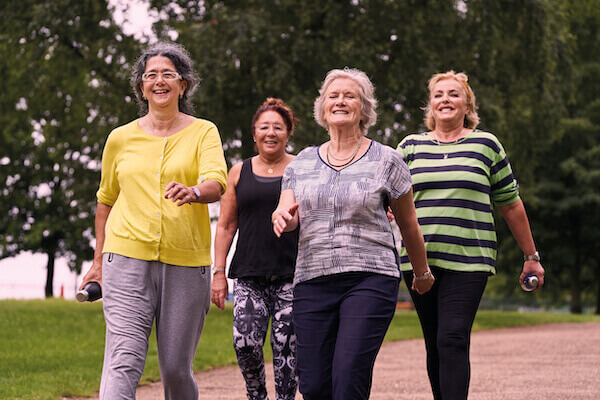
Some virtual challenges raise money or awareness for a charity. When the cause is close to you, the walk can feel like more than exercise.
A cold morning or a final few kilometres may still be uncomfortable. But the reason for doing them has changed. You are not only trying to complete a distance; you are remembering someone, supporting a community or helping fund work you believe in.
This can add what behavioural researchers call prosocial motivation: the wish to do something that benefits other people. It can also strengthen belonging. Each participant may be walking in a different place, but everyone is contributing to the same larger effort.
A small study of 44 people at a charity walk found that motivation to take part was linked with the feeling of making a difference for the cause. Just over half said raising money or awareness was their most important reason for participating. Because this was a small observational study, it cannot tell us whether the cause made people more active in the long term.
Cause alone may not be enough. A 12-week virtual 5K charity program enrolled 43 people, but only 11 completed it, and the researchers found no clear improvement in motivation or confidence. Participants described the solo virtual format as isolating. The researchers recommended group participation, more accountability and allowing people to choose a charity that mattered to them.
The practical message is simple: meaning works best alongside structure and people. Choose a cause you genuinely care about, learn what the fundraising supports and tell your supporters why it matters to you—if you are comfortable doing so. Then keep the walking plan realistic.
Fundraising should not become another leaderboard. A modest target, an honest update or a conversation that raises awareness can still be valuable. The amount on the page is not the only measure of your contribution.
Everyday walking starts to feel worthwhile
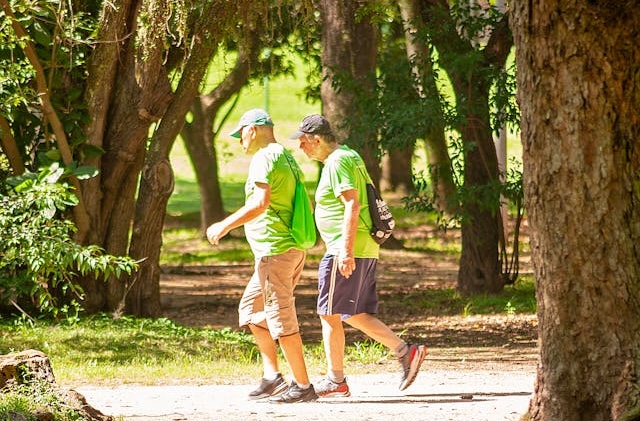
Walking often happens in small pieces: ten minutes before work, a trip to the shops or an evening loop with the dog. A challenge joins those pieces together.
That extra movement can support your physical and mental health. Walking is free, can be split into short sessions and is easy to do with other people, as healthdirect explains in its guide to walking for exercise.
The challenge itself does not guarantee a health result. Its benefit is that it can help you move more often—and regular movement is what matters.
Not every leaderboard is fair
Imagine two people enter the same challenge.
One starts at 3,500 steps a day and adds 2,000. The other already walks 18,000. The beginner has made the bigger change, yet still looks as though they are losing.
The large app study found that competitions worked less well when people with very different starting levels were matched together. In seven-day competitions, the person who finished last even walked slightly less than usual on average.
A more welcoming challenge might reward:
- improvement from your own starting point
- the number of active days
- consistency across the week
- team progress
- a personal target that can be adjusted
There is nothing wrong with enjoying competition. It just should not be the only way to succeed.
Part two: What happens after the challenge ends?
The app stops congratulating you. The team chat goes quiet. The target that organised your week disappears.
This is the real test: does any of the extra walking become part of normal life?
The drop-off can be steep
An Australian study followed 1,836 people who registered for a 10,000 Steps Walking Challenge linked to the 2006 Commonwealth Games in Melbourne.
Only 49.8% of those who registered logged any steps. Of the people who did log steps, 45.5% continued beyond the challenge and 16.6% kept logging for more than a month afterwards.
A much smaller group of 53 people completed all the follow-up surveys. They estimated that their daily steps rose from 6,401 before the program to 9,921 during the first survey, then settled at 8,727 later.
That sounds encouraging, but we need to be careful. The group was small, and people were asked to estimate how active they had been before the program. The clearest finding is that the challenge created an immediate lift, but only a small share of participants kept using it for long.
Keeping some of the gain is still a win
Research on physical-activity programs more broadly gives us a more hopeful picture.
A 2021 review looked at successful programs that measured activity for at least three months after support ended. On average, people kept about 60–80% of the original improvement. That worked out to roughly 45 extra minutes of moderate-to-vigorous activity a week or 945 extra steps a day compared with control groups.
This was not a review of virtual walking challenges alone, and it focused on programs that had already worked. Still, it offers a useful lesson: activity often falls after a program ends, but it does not always fall all the way back to the starting point.
Results over longer periods are less certain. One review of previously inactive adults found a small benefit at least six months after programs ended. Programs tended to do better when they included a clear plan, reminders, gradual increases, practice and small rewards.
A newer 2026 review looked specifically at apps and other digital-only programs. It found a small positive result after the programs ended, but the evidence was not strong enough to rule out chance.
In plain English:
- some people keep much of the extra activity
- most people ease back from their challenge peak
- an app on its own is unlikely to build a lasting routine
- a simple plan, regular feedback and support from other people may help
Seven ways to keep walking after the challenge
You do not need to preserve your biggest challenge week forever. You need a version that still works on a rainy Wednesday when life gets busy.
1. Pick your realistic minimum
Before the challenge finishes, choose the smallest routine you want to protect.
It might be a 20-minute lunchtime walk three days a week, or a short walk after dinner from Monday to Friday.
The Heart Foundation recommends small, realistic goals and building up gradually. Your goal after the event can be lower than your challenge target and still be a meaningful step forward.
2. Decide exactly when and where you will walk
“I will keep walking” is easy to postpone. Make the plan specific:
After lunch on Monday, Wednesday and Friday, I will walk my usual 20-minute route before returning to work.
This removes one decision from your day. Clear planning was also linked with better long-term results in the research review.
3. Keep tracking—but choose a kinder score
You can keep using your phone, wearable, pedometer or a paper diary without chasing a public ranking.
Track what supports your goal: active days, walking minutes, weekly distance or planned walks completed.
Healthdirect recommends setting a realistic goal and tracking progress. It also points out that 10,000 steps will not suit everyone. A useful target is one that starts from where you are now.
4. Make walking the easy option
Put your shoes beside the door. Block out walks in your calendar. Link a walk to something that already happens, such as lunch, the school run or your favourite podcast.
These small reminders matter. Research suggests that prompts and cues can help people keep going after a program ends.
5. Keep one social connection
If your team or Facebook group helped, do not let every connection disappear on the final day. Invite two or three people to continue a weekly check-in, arrange a regular walk or join a local walking group.
Healthdirect suggests walking with a friend or joining a group. The main challenge group may become quieter, but the most useful relationships can continue.
6. Find a reason that matters to you
A badge is an outside reward. It can get you started, but it may not be enough to keep you going.
Think about what walking gives you: more energy, a clearer head, time outdoors, better sleep or an easy way to catch up with someone. Your reason may also be a charity or community that matters to you.
The American College of Sports Medicine recommends choosing a personal reason and making your goal clear and measurable in its guide to fitness goals that stick.
If the challenge supported a cause, decide whether you want to stay involved after the event. That might mean another walk, a regular donation, volunteering or simply continuing to share reliable information about the cause.
7. Have a plan for messy weeks
Rain, travel, illness and busy days will interrupt the routine. That does not mean you have failed.
Choose a fallback: a ten-minute indoor walk, the stairs at work or one short loop instead of the full route.
The Better Health Channel recommends adjusting goals when life changes. If you stop for a while, restart small. You do not have to repay a step debt.
What should you aim for?
Australia's movement guidelines recommend that adults move on most days, preferably every day. This can include 30 minutes or more of moderate-to-vigorous activity on most days, along with strength and other types of movement.
Walking can be part of that mix, but it does not have to do all the work. Strength training, cycling, swimming, balance exercises and other activities you enjoy can all have a place.
If you are new to exercise, returning after a long break or managing a health condition, ask your doctor or another qualified health professional about a suitable starting point.
Before the finish line: make your handover plan
During the final week of your challenge, write down:
- What helped you walk: the time, route, people and reminders.
- What got in the way or made the challenge feel harder than it needed to.
- The smallest weekly routine you want to keep.
- When and where your walks will happen.
- Who can keep you company or check in.
- A date four weeks later to see what needs adjusting.
The verdict
Virtual walking challenges can work. They give you a target, make progress visible and can help you move more—particularly if you are starting from a lower activity level.
But the biggest benefit is not necessarily the medal or your final position.
It is finding a time, route, goal or group that makes walking easier to repeat.
The challenge gets you to the finish line. A simple routine helps you keep going afterwards.
Ready to find a challenge? Browse virtual sports and fitness events across Australia, including virtual running events and virtual walking events. Check the organiser's current rules and choose a target that suits your starting point.