

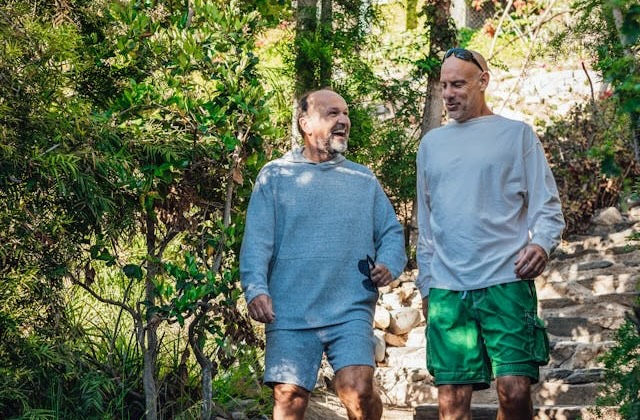
More than half the men who join The Man Walk say they feel lonely.
That number stops you for a second.
Not because loneliness in men is rare, but because it is usually invisible. It often looks like being busy, keeping to yourself, or saying "all good" when things are anything but.
A new Australian study of 377 participants in The Man Walk found something powerful: men who kept showing up to walk together over time reported lower rates of depression symptoms and healthier drinking habits.
No therapy room. No formal program. Just a regular walk, at the same time, with the same group of people.
It raises an interesting question: can something as ordinary as a weekly walk become one of the most practical mental-health habits a man can build?

What is The Man Walk?
The concept is simple.
Pick a time. Pick a route. Turn up.
The Man Walk began on the NSW South Coast when founder Mark Burns, a physiotherapist from Gerringong, started walking with mates around Kiama Harbour. What started as a small local habit has grown into a nationwide community.
There is no membership fee, no expectation to share personal stories, and no pressure to perform. The walk itself is the reason to come. Conversation, if it happens, happens naturally.
That simplicity may be exactly why it works.
What the research found
In 2026, researchers from Charles Sturt University published the first national study of The Man Walk in BMC Public Health.
The study surveyed 377 men across 121 Australian postcodes, with most participants aged 55 and over.
The findings were striking.
Fifty-four per cent reported experiencing general loneliness.
That matters because loneliness is increasingly recognised as a major health issue, linked to depression, poor physical health, and higher long-term health risks.
But the more interesting finding was what happened over time.
Men who had been part of The Man Walk for three years or longer showed significantly lower odds of depression symptoms compared with newer participants.
Those attending eight or more walks per month also showed lower odds of risky alcohol use.
The pattern was clear: consistency mattered more than intensity.
Why walking works differently
Walking creates a different kind of social space.
There is less pressure than sitting across from someone in a formal setting. You are moving, looking ahead, and sharing the same environment.
That changes the rhythm of conversation.
Topics come and go. Silence feels natural. Talking feels optional.
For many men, that format can feel easier to enter than traditional support settings.
In the study, the most commonly reported benefit was social connection. Nearly three-quarters of participants listed socialisation as one of the main reasons they kept coming back.
Physical health and mental wellbeing followed closely behind.
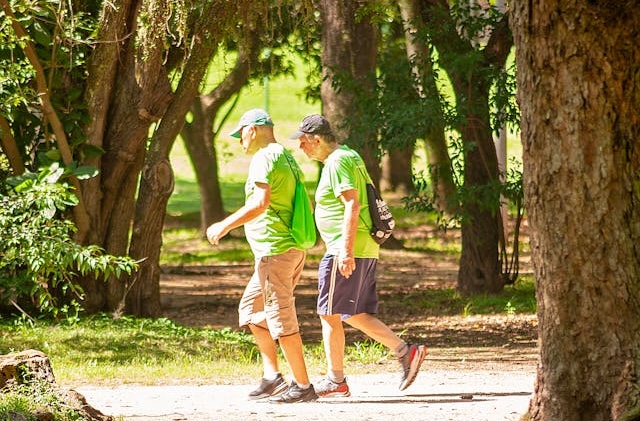
From one harbour walk to 40 locations
The Man Walk has expanded quickly.
By late 2024, the NSW Government committed $100,000 to support the program's growth, recognising its role in supporting community wellbeing.
At that point, there were already 40 active weekly walk locations across New South Wales, from Albury to Tenterfield, with thousands of attendances recorded across just a few months.
Today, the network continues to grow, giving more men an easy way to connect without needing a big reason to start.
What the study does not prove
It is worth being clear about what this research shows and what it does not.
This was a cross-sectional study, which means it looked at participants at one point in time rather than following them over many years.
That means researchers cannot say the walks directly caused the mental-health improvements.
It may be that men who are already coping better are also more likely to stay involved.
But even with that limitation, the findings highlight something important: regular social movement appears to be linked with better outcomes.
And that is valuable on its own.
How to find a walking group near you
If The Man Walk sounds like something you or someone you know could benefit from, the easiest next step is simply finding a local walking group.
KeepActive's walking groups directory lists community walking groups across Australia, including Man Walk chapters and other local walking communities.
You can search by suburb, postcode, or city to find regular walks nearby.
If you are in Victoria, you might also like our guide to free guided walks in Melbourne.
If you want to explore The Man Walk directly, their official chapter map lists all current locations and meeting times.
What if there is no Man Walk near you?
You do not need an official chapter to start walking with others.
The value is in the rhythm: same day, same time, same people.
That structure builds familiarity, and familiarity builds connection.
If there is no Man Walk in your area, you can explore other walking groups nearby or even start something informal yourself.
It does not need to be complicated.
One message. One meeting point. One lap around the block.
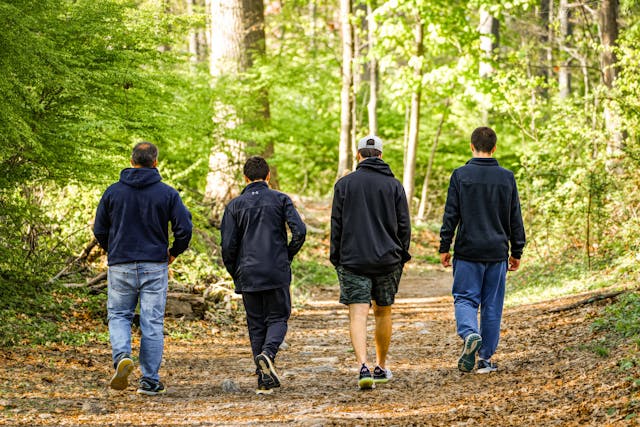
The bigger takeaway
The story here is bigger than one program.
It is about how movement creates connection.
And how connection, repeated often enough, can become part of how people stay well.
For many men, showing up for a walk may feel easier than "asking for help". But sometimes the outcome can start in the same place: being around other people, regularly, without needing to explain why.
If someone comes to mind while reading this, maybe the invitation does not need to be complicated.
Find a walk near you and ask if they want to come along.
If you are struggling with your mental health, speak to your GP or contact Lifeline on 13 11 14 for support.