

If you're a woman in your 40s, 50s, or 60s, you've probably heard the general advice: exercise is good for you. But "good for you" undersells what a new Australian study has found. Women who exercised regularly through middle age had half the rate of premature death compared to those who didn't. Not a modest reduction. Half.
The research, published in PLOS Medicine, comes from the University of Sydney's Prevention Research Collaboration and draws on one of the world's largest longitudinal women's health studies. It tracked more than 11,000 Australian women born between 1946 and 1951 over a 15-year period, from their mid-40s through to their early 70s. The headline number — a 50 per cent reduction in all-cause mortality — lands harder when you see the raw figures: 5.3 per cent of women who consistently met exercise guidelines died during the study period, compared to 10.4 per cent of those who consistently didn't.
What the Study Actually Measured
Most research on physical activity and health relies on a single snapshot — one survey, one point in time. This study did something different. Lead researcher Dr Binh Nguyen's team used data collected approximately every three years from 1996 to 2019 through the Australian Longitudinal Study on Women's Health (ALSWH), which has followed more than 58,000 women since the mid-1990s.
Rather than asking whether women exercised at one moment, the researchers tracked whether they consistently met the World Health Organization's guideline of at least 150 minutes of moderate-to-vigorous physical activity per week over multiple years. They used a method called "target trial emulation" — essentially modelling a long-term randomised controlled trial using observational data. It's a technique that's difficult to pull off with short studies, but powerful with a dataset spanning 15 years.
Joanne McVeigh, a movement behaviour scientist at Perth's Curtin University, said true randomised control trials on this topic would be "short, costly, and prone to participant retention issues." She described this methodology as providing "reliable evidence" and noted it was one of the first times the approach had been applied to a longitudinal physical activity dataset.
What the study didn't settle
The findings on all-cause mortality were strong. But the picture for specific causes — cardiovascular disease and cancer deaths — was less clear, with results described as uncertain. The study also relied on participants' self-reported exercise levels, a common limitation in this kind of research. And importantly, the evidence for women who started meeting guidelines partway through midlife — say at 55 or 60 — was inconclusive. The clearest benefit went to those who stayed active consistently.
Why Midlife Is When It Matters Most
Dr Nguyen was direct about why this age group matters: "It's so important to remain physically active during this life stage because it can provide long-term health benefits." But she also acknowledged the reality: midlife women are often juggling caring for children and ageing parents, working full-time, and managing the hormonal shifts of perimenopause and menopause. Physical activity is frequently the first thing dropped.
The numbers reflect that. According to the Australian Institute of Health and Welfare, 37 per cent of Australians aged 18 to 64 are not meeting physical activity guidelines. For those 65 and older, it's 57 per cent. Women in midlife — caught between competing demands — often fall squarely into that gap.
Stuart Biddle, a professor of physical activity and health at the University of Southern Queensland, pointed to the environment as part of the problem: "We have too many cars, too much automation, too much sitting." The opportunities to be active exist, he said, but the default settings of modern life push against them.
What Counts as Enough Exercise
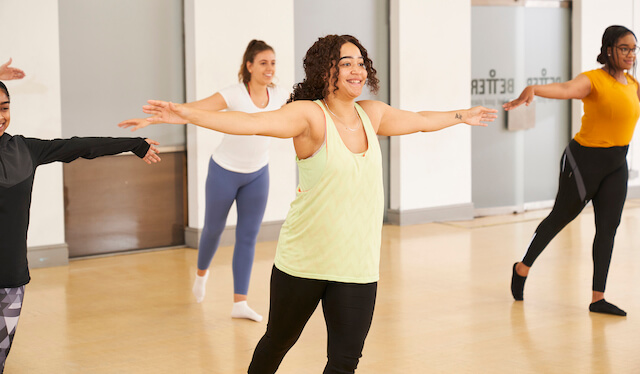
The study measured against the WHO's recommendation of at least 150 minutes of moderate-to-vigorous intensity exercise per week. That's roughly 30 minutes on five days — a brisk walk, a swim, a social tennis hit, a group fitness class.
Australia's own 24-hour movement guidelines go slightly further. They recommend moderate- to vigorous-intensity activity for 30 minutes or more most days, plus muscle-strengthening activities on at least two days per week, and limiting sedentary time. Few Australians meet the full set. But the study's findings suggest that even meeting the aerobic component consistently delivers substantial protection.
Dr McVeigh's practical advice: "Find something you enjoy, fit it into your day, and build from there. Aim for 30 minutes of brisk walking five days a week, lift weights or do bodyweight exercises twice a week, and include some balance or yoga."
Getting Started Doesn't Require a Gym Membership
One of the more encouraging aspects of the research is that it measured physical activity broadly — not gym attendance, not structured sport, not high-intensity interval training. Walking counts. Gardening counts. Playing with your kids at the park counts, as long as the intensity and duration add up.
For women who've been inactive for a while, the barrier isn't usually knowledge — it's momentum. The idea of going from zero to five sessions a week feels unrealistic when you're already stretched thin. But starting slow has its own evidence base. Even small increases in activity — a 15-minute walk at lunch, taking the stairs, parking further from the shops — begin to shift the baseline.
Walking groups are one of the most accessible entry points, particularly for women who find solo exercise harder to sustain. They're typically free, run in local parks, and attract people across a range of fitness levels. For those looking for something more social or structured, local activity groups — from social netball to yoga to aqua aerobics — offer a way to build consistency without needing a personal training plan.
It's Not Too Late — But Consistency Is the Key
Professor Biddle made an important point: "You can't say, 'I was physically active 10 years ago, I'm not physically active now, but it doesn't matter.' You are either physically active now and getting the benefits, or you're not." Past activity doesn't bank indefinitely. The protective effect in this study came from sustained activity over years.
That said, all three experts quoted in the research agreed on one thing: it's never too late to start. Dr McVeigh put it simply: "The kids may be older, you know yourself better." For women entering their 50s or 60s with more time and fewer caregiving demands, this can actually be a window of opportunity — not a closing door.
If you're looking for ideas on where to begin, getting back into exercise after a break covers the practical side. And if motivation is the sticking point, overcoming common exercise excuses is worth a read — not because the excuses aren't real, but because most of them have workarounds.
The full study, "Physical activity across mid-life and mortality outcomes in Australian women: A target trial emulation using a prospective cohort," is available in PLOS Medicine.